

Wellness Things That Are Not BS: Red Light Therapy
Is red light therapy a waste of time? Let's chat.

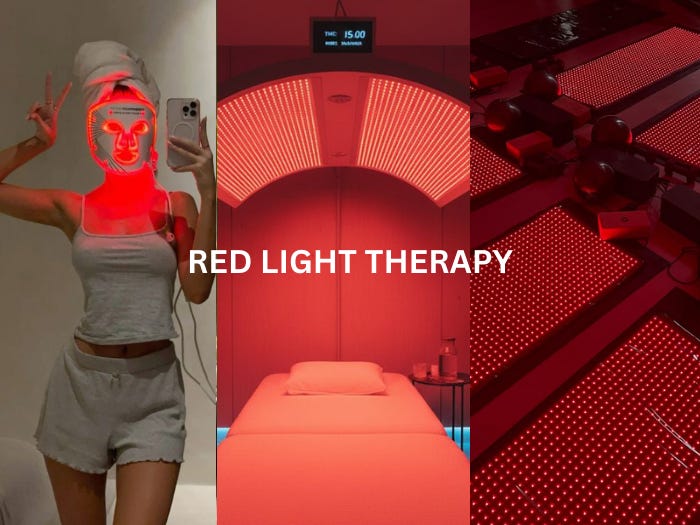
I’ll be honest with you. When I first heard about red light therapy, I assumed it was one of those things that a very aesthetic, very rich person had invented to justify buying a $4,000 panel and posing in front of it in a matching linen set.
And if you read my substack, you know my whole goal is to de-influence you from getting wellness shit you don’t need.
But here’s the thing. I kept coming back to it. The research kept showing up in my feeds, in clinical journals, in conversations with people I respect. And then — I pulled the trigger. I bought myself a panel. Actually, I asked my mom to get it for my birthday haha.
And now? I’m a convert. Like, genuinely. Here’s why.
This is Wellness Things That Are Not BS, my series where I break down what’s actually worth your time and money in the wellness world.
I’ve covered a lot of topics: vagus nerve stimulation, intermittent fasting, lymphatic drainage, creatine, nutrient timing, fascia release, castor oil, and more.
Buckle up because this one gets a little nerdy. In the best way.
I. Introduction
What actually is red light therapy?
Red light therapy — also known as photobiomodulation (PBM), low-level laser therapy, or LLLT — is the use of specific wavelengths of red and near-infrared light to trigger biological changes in cells.
The wavelengths we’re talking about are roughly 600–700 nm for red light, and 800–1100 nm for near-infrared (NIR). These wavelengths sit in what researchers call the “optical window” of biological tissue — meaning they can penetrate skin, muscle, and even bone without causing damage. Unlike UV light, which can fry your DNA and cause cancer (no bueno!), red and near-infrared light don’t heat or destroy tissue. They talk to it.
It sounds a bit woo, I know. Shining a red light at yourself doesn’t feel particularly medicinal. It feels a bit like standing in a nightclub bathroom lol.
But here’s what’s happening underneath your skin.
How does red light therapy actually work?
The mechanism sits in your mitochondria, which — if you haven’t had the pleasure — are the tiny organelles inside your cells responsible for producing energy.
Specifically, they produce ATP (adenosine triphosphate), which is essentially the body’s energy currency. Every cellular process that happens in your body requires ATP. Your immune function, your tissue repair, your brain activity, your mood, your recovery — all of it runs on this stuff.
Inside the mitochondria, there’s an enzyme called cytochrome c oxidase (CCO). This enzyme sits at the end of the electron transport chain — the process your mitochondria use to generate ATP. And here’s the wild part: CCO is a ✨chromophore✨. That means it absorbs light. Specifically, it absorbs red and near-infrared wavelengths.
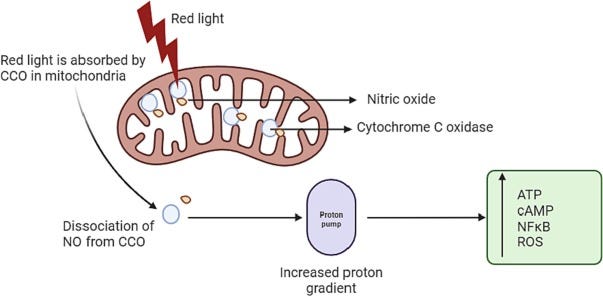
When CCO absorbs these photons, it becomes more efficient. The electron transport chain speeds up. ATP production increases — some studies suggest by around 30–40% in metabolically stressed cells.
As a downstream effect, you get reduced oxidative stress, modulation of inflammatory signaling, and improved cellular function across the board. Good news!
There’s also a secondary mechanism involving nitric oxide (NO). In inflamed or stressed cells, nitric oxide binds to CCO and blocks its activity — essentially turning the lights off on your cellular energy production.
Red light photodissociates (read: kicks out) this nitric oxide, restoring CCO function and allowing ATP production to resume. This is particularly powerful in tissues that are injured, inflamed, or under chronic stress.
So in plain English: red light gives your mitochondria a reboot. And because your mitochondria are involved in literally everything, a mitochondrial reboot has ripple effects across your whole system.
Worth noting: this is not photosynthesis. You are not a plant. The energy conversion is much smaller — around 0.2% efficiency compared to a plant’s 0.5–1.5%. But even a 1–2% increase in cellular ATP is clinically meaningful, particularly in people who are dealing with chronic stress, inflammation, injury, or just the general entropy of being a human in 2026 :’)
II. The Research
Okay here’s where it gets really good.
Red light therapy has been studied since the 1960s — when a Hungarian scientist named Endre Mester discovered, accidentally, that low-level laser light stimulated hair growth in mice. Since then it’s accumulated thousands of clinical trials. The National Library of Medicine added “photobiomodulation” as an official Medical Subject Heading in 2015, which — for a research nerd like me — is basically the moment it got its PhD.
Here’s a breakdown of where the evidence is strongest, and where it’s still catching up.
Skin: collagen, aging, acne, and wound healing
This is where the evidence is most robust. Multiple randomized controlled trials show that red light therapy:
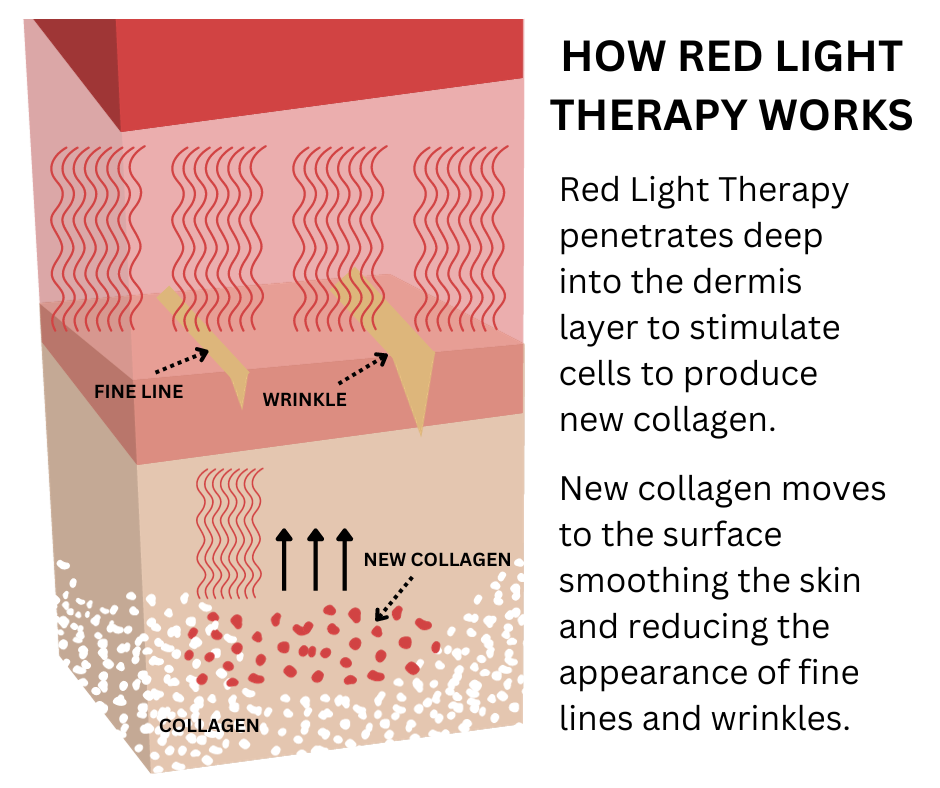
Stimulates collagen production and improves skin elasticity, reducing the visible appearance of fine lines and wrinkles
Improves skin texture and reverses signs of photoaging — one split-face RCT found wrinkle reductions of up to 36% and elasticity improvements of up to 19%
Reduces acne — a 2025 narrative review of 59 studies across 1,882 patients found acne to have the strongest evidence base of any dermatological application
Accelerates wound healing by stimulating cellular proliferation and tissue repair
For skin specifically, the FDA has cleared several home-use red light devices for acne. That’s not nothing. The FDA is not a liberal institution when it comes to wellness claims. (Note: devices are cleared for safety via the 510k process — not always independently validated for efficacy, so this claim should be worded carefully.)
Pain and inflammation
A review of 11 RCTs on red light therapy and pain found mostly positive results. An umbrella review published in 2025 covering 15 meta-analyses of RCTs found PBM beneficial across multiple pain outcomes — with the strongest support for fibromyalgia, osteoarthritis-related disability, and myofascial pain — though evidence certainty was mostly low-to-moderate, and researchers noted further standardized trials are needed.
Key caveat: the pain relief often returned within weeks of stopping therapy. So this is a consistent practice, not a one-time fix.
Cognitive function and brain health
A 2021 systematic review of PBM and dementia found positive results across all 10 clinical studies included. Research in healthy adults also shows improvements in reaction time, attention, and executive function — a 2022 systematic review of 35 studies found 82.9% reported positive cognitive improvements after transcranial PBM.
The mechanism is the same: mitochondrial support in the brain. Neurons are extraordinarily energy-hungry — they consume more ATP per cell than almost any other cell type in the body. When neuronal mitochondria are better supported, cognitive function improves.
Cardiovascular fitness and VO₂ max
Multiple studies show improvements in VO₂ max and endurance performance. A 2015 systematic review with meta-analysis found that phototherapy consistently improved muscular performance and accelerated recovery when applied before exercise, with the vast majority of included clinical trials showing significant improvements.
Blood sugar regulation
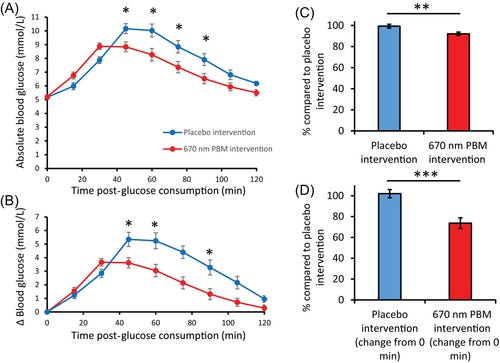
A 2024 study published in the Journal of Biophotonics found that 670 nm red light exposure reduced blood glucose spikes — by around 27.7% in trials. That is clinically significant. That is in the territory of some medications. The mechanism: improved mitochondrial activity increases glucose demand at the cellular level, essentially helping cells absorb and use glucose more efficiently.
Hair growth
One of the most robustly evidenced applications. Multiple reviews confirm that red light therapy can stimulate follicle activity and support regrowth in androgenic alopecia. It was, famously, the first application discovered — back in Mester’s mice in the 1960s.
What the research is NOT showing (yet)
I’ll be upfront: some claims are not well supported.
Weight loss and cellulite are getting a lot of airtime on social media and the evidence is thin. Cancer treatment claims (beyond dermatological photodynamic therapy in clinical settings) are not something you should be trying at home.
Mental health benefits like depression and SAD — not enough data yet, even if mechanistically plausible. Just being honest!!
The general pattern of the literature: the closer to the skin, the stronger the evidence. The more systemic the claim, the more we’re in “promising but preliminary” territory.
III. How to Use Red Light Therapy
The basics: wavelength, dose, and duration
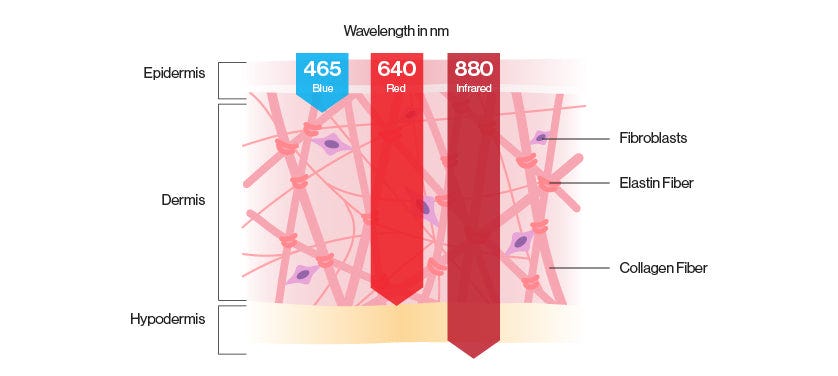
Not all red light is the same. The wavelengths that have the most research behind them are:
630–670 nm — for skin surface: collagen, wound healing, acne
810–850 nm — for deeper tissue: muscle recovery, inflammation, joint pain
Near-infrared (850–1000 nm) — deepest penetration: neurological, systemic effects
Most good devices cover both red and NIR wavelengths. If you’re buying a panel, look for one that does both.
On dose: there’s a biphasic dose response in PBM, which means more is not always better.
Low-to-moderate doses stimulate.
High doses can actually inhibit.
Key!
For most home devices, sessions of 10–20 minutes, 3–5 times per week, sitting or standing around 15–30 cm from the panel, is roughly where the research lands for meaningful effect. Distance matters — too far and you’re not getting an effective dose.
On duration: like ashwagandha, like most good things, red light works cumulatively. Most studies that show meaningful outcomes are run over 8–12 weeks minimum. Give it time.
My experience
I bought (/my mom bought me) this red light panel. I started using it a few times a week for about 15 minutes — transparently less than intended because it’s kinda a lot of effort in this particular season of my life. But I noticed better skin quality and a lil energy boost — could be placebo, but what is even a placebo ya know?? Also seems to help me unwind well after a particularly stressful day. Definitely seems to support nervous system regulation.
What I will say is that the applications that feel most relevant to my life right now are the mitochondrial and inflammatory ones.
Being postpartum, being exhausted, being under chronic low-grade financial and logistical stress — all of those things tank mitochondrial efficiency. The ATP angle genuinely excites me. Not in a bro-optimization way. In a “my cells are more tired than I am and I would like to help them” way.
What to actually buy (and what to ignore)
My personal product recommendation, not sponsored but it is an affiliate link (let me live!!!).
The market is absolutely flooded with red light products, and the quality varies enormously. Some things to look for:
Irradiance (power output): measured in mW/cm². You need at least 20–100 mW/cm² at the treatment distance. Many cheap panels underdeliver here.
Wavelength specificity: the panel should specify exact nm ranges, not just say “red and NIR”
Third-party testing: any reputable brand will have independently verified their output specs
Panel size: small panels are fine for targeted use (face, knee, shoulder). Full-body panels cost more but deliver more.
The home market has exploded in the last few years and quality has improved. You don’t need to spend $4,000. But you probably do need to spend more than $30 to get something that actually works.
Side effects and who should be cautious
Red light therapy is genuinely very safe. There’s no UV, no heat damage, no ionizing radiation. The main risks:
Eye exposure: don’t look directly at the panel without appropriate eye protection. Near-infrared is invisible and you won’t realize you’re exposing your retinas
Thyroid: there’s some (limited) evidence that red light over the thyroid can affect thyroid hormone levels — if you have a thyroid condition, worth talking to your doctor
Photosensitive medications: some medications (like certain antibiotics or acne drugs) increase photosensitivity. Check with your prescriber
Pregnancy: limited research, so exercise caution
Otherwise? Go wild.
Final Words
Look, I want to be real with you for a second.
Red light therapy is a little bit of a gimmick. It probably won’t drastically transform your life. Neither will ashwagandha, or lymphatic drainage, or any of the other things I’ve written about in this series. None of them work in isolation. None of them override sleep deprivation, chronic stress, a bad diet, or a genuinely difficult set of life circumstances.
But. When you are in the weeds — and I am very much in the weeds :’) — having tools that support your biology without requiring much of you is really, genuinely useful. Ten to twenty minutes. Sitting or standing. Not scrolling your phone ideally. Just... letting your cells do something restorative.
That’s not nothing <3
Red light therapy is one of those things that, the more I research it, the more I understand why it works, and the more I think it deserves a serious place in the wellness conversation rather than being relegated to expensive spa treatments and biohacker bro content.
Your mitochondria are doing a lot for you. Maybe give them a little light baby!
If you made it this far, you’re my people. The paid tier is where I share the frameworks I actually use — for stress, energy, health, and staying sane in real life. Come hang 🫶
In good health, Emilina xx
Have a personal health or life question you want me to answer in depth? Fill out this anonymous Ask Emilina form.
Another great article Emilina, very well written as always. I’ve been using red light therapy for about 3 years now and I love it. I definitely agree with you regarding improving skin elasticity and minimizing fine lines and wrinkles. I’m a 72 year old male and I have noticed that my crows feet have almost disappeared and the other wrinkles have soften up. My hair and fingernails grow like crazy. I live in the Pacific Northwest of the USA, it’s get dark here a lot, it does help with SAD.
I love the panel you got, great price also.
Thanks for sharing, love your content, keep writing (your good at this)
Take care, be safe
Have you tried an infrared sauna? I love that also.
In adding to my previous comment, I like red light therapy too and did some of the same deep digging you did when I first started encountering it and questioning it. Came to the same conclusions. 😊