


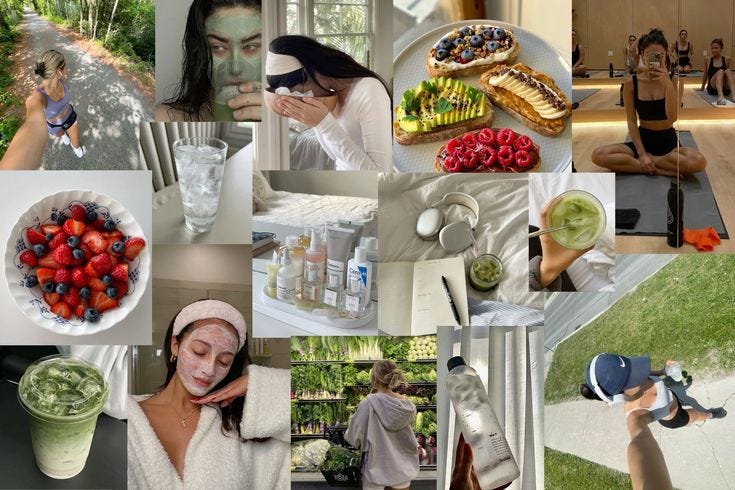
The majority of the ~ wellness world ~ consists of expensive supplements, esoteric practices, pilates, matcha, and a lot of free time for very extensive morning routines.
But it’s an illusion, my friend.
I’ve been in the health industry for a decade. I’ve worked on the customer side: as a health coach, nutritionist, and personal trainer. I’ve worked on the brand side: for Oura, Nike, Gold’s Gym, and more. But my longest-standing position has been consumer.
I am the target market for every single brand I write for. I am the wellness girlie who drinks matcha, goes to pilates, and practices weird kundalini breathing.
But because of my experience from each point of the wellness triad, I’ve learned a lot about what is faff and what has function. While I love wellness, it can be extremely elitist, expensive, and overall pretty excessive.
What about wellness when you’re broke? Can you still be healthy if you’re living on government aid? Do you need to buy new activewear every month, have a ClassPass subscription, or a rich husband who funds your free time?
No!
I feel strongly about getting the message out there to anyone and everyone that the healthiest things you can do are free. Completely free. Not a bit cheap. Literally FREE.
The foundation of health is free
Look at any research paper in the world that seeks to establish what makes people healthy, and this is what you’ll find (in no particular order):
Movement
Sleep
Healthy food
Sunlight + nature
Hydration
Social connection
No ifs, no buts. That is the list.
Let me jump in before you say WeLL HeaLthY FoOd IsnT FreE. Yes. It’s true. I literally wrote my bachelor’s degree thesis on food deserts in the US. I understand food inaccessibility. Some people in the US can only get food from fast food outlets or gas stations. That is the reality.
However, the advice I’d have for you: Buy food that keeps, like potatoes, beans, rice, canned meats. Grow your own food as much as you can.
You don’t need to rely on junk when there are healthier, cheaper alternatives. Contrary to popular belief: Fast food is not the cheapest option. A can of black beans, some rice, onions, and garlic. You’ve got yourself a meal. And for what? 50 cents a portion, probably.
The foundation of health is free. Access to these pillars of health is your birthright.
When wellness got woke
I’m not sure when it exactly happened, but at some point in time, wellness became consumerism 101.
The timeline is pretty clear if you zoom out. In 2014, the global wellness market was valued at around $3.4 trillion. By 2023, it had exploded past $5.9 trillion. That’s almost double in under a decade — and yet, during that same window, rates of chronic illness, anxiety, obesity, autoimmune disorders, and burnout have all gone up, not down.
In the US alone, adult obesity has climbed to 42%, anxiety disorders are affecting 31% of adults, and autoimmune diagnoses have risen by roughly 4–9% every single year.
Meanwhile, wellness brands are out here telling you your problems can be solved with a $90 collagen powder.
Make it make sense.
When you overlay the graphs — wellness spending going up, population health going down — it forces you to ask the uncomfortable question: does wellness actually work, or have we just built a very aesthetic coping mechanism?
Because here’s the real plot twist: the science-backed pillars that actually improve health haven’t changed in 50 years. They’re the same ones public health researchers have been screaming about since the 1970s. Movement. Sleep. Community. Sunlight. Real food.
And that’s where the inverse correlation comes in: The more we funnel our time, money, and identity into “performing wellness,” the less we engage in the unsexy, free, foundational habits that actually move the needle. Maybe that’s why wellness doesn’t work.
How to stop performing wellness
I started a weekly series called Wellness Things That Are Not BS, taking an in-depth look at popular wellness trends to help you understand what does and doesn’t work. Follow along.
Performative wellness looks different for everyone. If you’re going through the motions of a certain practice and it isn’t aligning with you, but you’re doing it anyway, that’s performative.
For me, I actually enjoy pilates, the taste of matcha (v sensitive to caffeine), and breathwork. But if you hate the taste of matcha, or don’t want to spend money on expensive pilates studios — don’t do it. It’s okay. You can still improve your health without all the symbols of 21st century comercialized wellness.
Remember: Fluff isn’t synonymous with function.
If you’re new to wellness or want to relicabirate for a second — just focus on the basics. The functional foundation — let’s call it.
Shift your energy from identity-based habits to outcome-based habits. Anchor your habits to how you want to feel e.g. I want more energy, I want better sleep, I want to feel more calm — you choose the simplest, most direct behaviors that actually create that result.
A 10-minute walk regulates your blood sugar as effectively as the $300 glucose-goddess-approved routine. Morning light improves circadian rhythm more than any sunrise alarm clock. Outcome first. Identity second.
Performative wellness dissolves when you stop curating who you look like or how you appear to others, and start supporting how you want to feel.
Wellness without money is not only possible, it’s always been the real version of wellness. You don’t need wealth to be well. The healthiest habits have always been, and will always be, free.
Absolutely true and I can attest to this as I haven't been particularly wealthy in the last few years. Walking and stretching/dancing are my free physical exercise and ones I actually enjoy (I don't like scheduled classes and following instructions).
I buy and cook inexpensive but nutrient dense food
I go out in the sunlight as much as I can, especially when I'm feeling down
Green tea is very healthy and relatively inexpensive (I also buy matcha but that can be more costly, green tea is literally 2-3 euros)
I don't buy activewear and just use normal leggings or cotton clothes.
What I spend more on is skincare, but that is because I love it and lately I can afford to pamper myself a bit more. But even there, anything you'd need would be a cleanser, a serum and a sunscreen.
I feel like I keep looking for a miracle cure to feel my best, but deep down I know that I just need to do these things consistently! In addition to being affordable today, if you prioritize movement, sleep, and healthy foods now, then future you will benefit and hopefully have fewer medical bills!