

15 Tricks to Never Stop Learning (Without It Feeling Like Work)
Become the smartest person in the room! What, like it's hard?


I have a deeply unfair advantage in life and I want to share it with you.
I am genuinely, pathologically curious. I find almost everything interesting. I read research papers for fun. I listen to lectures on my walks. I have approximately 47 open tabs at any given moment and I genuinely intend to read all of them (even if I don’t get that far😆).
I’ve always considered myself good “learner.” I did well at school because I learned how to pass exams. I knew how to retain information, learn new things, and connect the dots between things.
To be clear, I’m not a genius. I just feel like I have the perfect combo of curious nature 🤝capable of learning efficiently. Let me teach you my ways!!!
Here are 15 specific, evidence-based ways to make learning a permanent background process of your life.
First, a brief note on how your brain actually learns
Your brain does not store information the way a hard drive stores files. It stores it as patterns of neural connections — synaptic pathways that strengthen each time they’re activated and weaken when they’re not. This is what Hebb’s Law means when it says “neurons that fire together 🤝wire together.”
The implication: learning is not a single event. It is a process of repeated activation. You don’t learn something by encountering it once. You learn it by encountering it multiple times, in multiple contexts, with gaps in between.
Most of what school got wrong about learning can be traced to violating this principle. Cramming for an exam activates a pathway once, intensely, and then it fades. The exam passes and the information goes with it. Real learning — durable, transferable, usable — looks completely different.

1. Use the spacing effect — review things just before you forget them
The spacing effect is one of the most robustly replicated findings in cognitive psychology, dating back to Hermann Ebbinghaus in the 1880s.
The principle: reviewing information at increasing intervals — just before you’d naturally forget it — produces dramatically stronger long-term retention than massed practice (cramming).
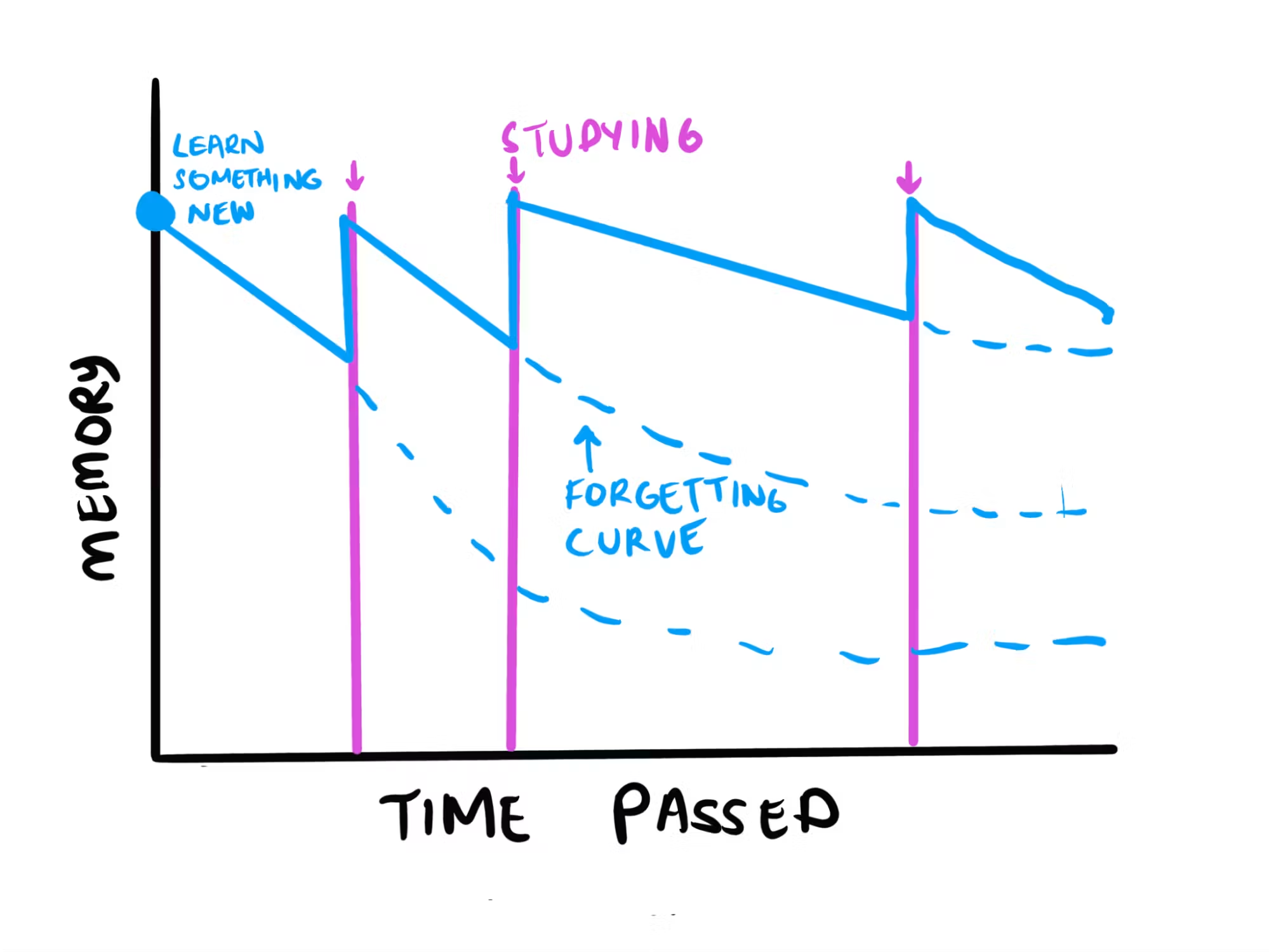
This video explains it well:
A 2006 paper by Cepeda et al. analyzed 317 studies across 14,000 participants and confirmed that spaced practice consistently outperforms massed practice for long-term retention, often by a factor of two or more.
The practical version: use Anki. It’s a free flashcard app that uses a spaced repetition algorithm to surface cards exactly when you’re about to forget them.
2. Learn by teaching — even to an imaginary audience
When I worked as a full-time agency health writer and long before AI, I would spend 10+ hours a day researching and writing health topics. At the end of the day, I would have learned so many cool things that I’d explain them all to my friends and family. To the point they were all like okayyyy! But seriously, the process of me teaching them what I learned indirectly helped me retain that information.
The Feynman Technique, developed by Nobel laureate Richard Feynman, is simple: take something you’ve learned and explain it as if you’re teaching it to someone with no background in the subject. Where you stumble is where the gap in your understanding is.
The neuroscience behind this is retrieval practice — the act of pulling information out of your memory rather than just recognizing it when presented strengthens the memory trace significantly more than re-reading. A 2011 study published in Science found that students who practiced retrieval after studying retained 50% more information after a week than those who re-studied the same material.
The practical version: after reading an article or finishing a podcast, explain the main ideas out loud to yourself, to your partner, to your kids, to your dog. Write a one-paragraph summary without looking at your notes. This Substack is, in part, me running the Feynman Technique in public lol.
3. Interleave your subjects — don’t master one thing at a time
This one feels deeply counterintuitive but the research is consistent. Interleaving — switching between different subjects or problem types during a study session — produces better long-term learning than blocking (mastering one thing fully before moving to the next), even though it feels less productive in the moment.
A 2014 study found that interleaved practice produced significantly better performance on later tests compared to blocked practice — despite participants feeling less confident during interleaved sessions.
The practical version: instead of reading one book cover to cover before starting another, read three books simultaneously in different domains. I often read a science book, a philosophy book, and a novel at the same time. The cross-pollination between subjects produces unexpected connections and the interleaving effect strengthens retention in all three.
4. Sleep on it
Sleep is not downtime for your brain. It is when consolidation happens — when the day’s experiences are transferred from short-term to long-term memory, with irrelevant information pruned and important information integrated into existing knowledge networks.
Research consistently shows that sleep after learning produced significantly better performance on motor tasks than the same amount of time awake. Ssleep actively replays newly learned information, strengthening synaptic connections in the process.
The practical version: if you want to retain something important, engage with it in the evening rather than the morning — and then sleep. Don’t cram and stay up. Engage substantively and then let your sleeping brain do the rest. This is one of the most underused learning hacks and it’s completely free.
5. Use the generation effect — struggle before you look up the answer
Do you know how quickly people use AI these days! God forbid you think about whether you know the answer for a couple seconds before immediately typing your question into chatgpt.
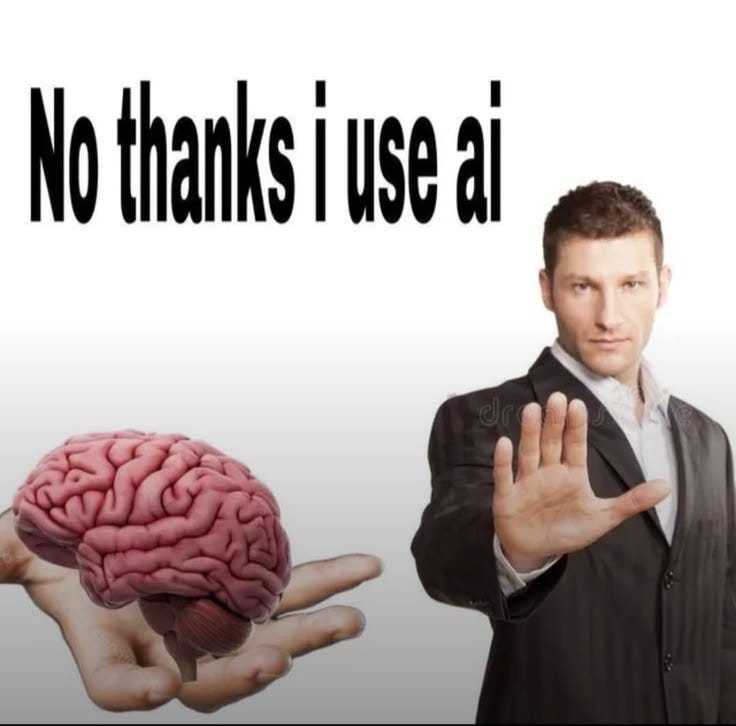
Trying to retrieve or generate an answer before looking it up — ! even if you get it wrong ! — produces significantly better retention than looking up the answer immediately. This is called the generation effect or the hypercorrection effect.
Research shows that when we confidently believe something incorrect and then discover the correct answer, we remember the correction more strongly than if we had simply been told the right answer from the start. The surprise and error activate the brain’s prediction error system, which flags the information as important.
The practical version: before you google or chatgpt something, take 30 seconds to try to remember or reason out the answer. Before you check a fact, guess first. When you read a headline, try to predict what the research will say before you read the article. This tiny friction dramatically improves retention.
6. Take notes by hand, not by laptop
Best believe I don’t go anywhere without my Moleskine and these exact pens from Temu lol (iykyk). I’m a WRITER baby! It helps with learning too.
Handwriting forces you to summarize and paraphrase, which is itself a generative act that deepens processing. Typing encourages verbatim transcription, which is essentially passive.
A widely cited 2014 study by Mueller and Oppenheimer at Princeton found that students who took notes by hand consistently outperformed laptop note-takers on conceptual questions — not because they wrote more, but because they wrote less.
The practical version: when you’re in a podcast, lecture, or meeting you want to learn from, have a notebook. Don’t transcribe. Translate — write the idea in your own words as if you’re explaining it to someone else. One line per idea. Diagrams or scribbles where useful.
7. Make it emotional — emotion is memory glue
You’ve probably heard this before: the reason we tell stories is that it helps our brains remember key info. Why emotive stories are so much more memorable than boring or one-dimensional stories.
The amygdala — your brain’s emotional processing centre — has direct connections to the hippocampus, which is responsible for memory consolidation. Emotional arousal at the time of encoding dramatically increases the likelihood that information will be retained. This is why you remember exactly where you were when you heard shocking news, but can’t remember what you had for lunch two weeks ago.
You can use this deliberately!
Connect new information to something you care about personally, find genuinely surprising, or have a strong reaction to. Write down why a piece of information matters to you specifically. Tell someone about it in a way that communicates why it’s fascinating.
The practical version: when you read something interesting, don’t just note the fact. Note your reaction to it. “This surprises me because...” / “This changes how I think about...” / “This connects to what happened when...” The emotional elaboration is the retention mechanism.
8. Walk while you learn
I am a walk and podcast girlie through and through!
Research from Stanford found that walking increases creative output by an average of 81% — specifically divergent thinking, which is the kind of lateral, associative thinking that produces insight and makes new information connect to existing knowledge. That’s major!!!!
And a 2022 meta-analysis confirmed that acute aerobic exercise enhances memory consolidation and retrieval.
The practical version: I listen to the most cognitively demanding podcasts and audiobooks on walks, not during passive time. The combination of light physical movement, increased blood flow to the brain, and the absence of screen stimulation creates an optimal state for absorbing complex ideas. Walking meetings also work — some of my best thinking happens mid-stride.
9. Use analogies aggressively
When you encounter a new concept, immediately try to find an analogy in a domain you already understand.
I know this sounds weird but sometimes I lay in bed at night and try to think of analogies of new things I learn. It’s so weird that these random analogies will help me retain information for YEARS. For example, it took me a while to fully understand heart rate variability. When I finally realized that it was similar to the ocean tide, it helped. Specifically, optimal HRV moves in and out with rhythm and force. An ocean with a constant catastrophic swell is not good, nor is a totally flat ocean. You need ebbs and flows.
Anyway back to this.
Analogical reasoning is one of the brain’s primary tools for encoding genuinely new information — it works by hanging the new concept on an existing conceptual hook rather than trying to create a new one from scratch.
This is why good teachers are disproportionately good at analogies. It is not just a communication tool. It is a learning tool.
The practical version: every time you learn something new, ask: what is this like? What existing thing does this behave like? What domain does this remind me of? Write it down. The stranger the analogy, the more memorable — the distinctiveness effect means unusual associations are retained better than obvious ones.
10. Embrace confusion — it means you’re at the edge
Desirable difficulties is a term coined by psychologist Robert Bjork at UCLA to describe learning conditions that feel harder in the moment but produce better long-term retention. Confusion, difficulty, and the feeling that you don’t quite understand something yet are not signs that you’re failing to learn. They are signs that you’re at the edge of your current understanding — which is exactly where learning actually happens.
The comfortable feeling of re-reading material you already know is the illusion of learning. The uncomfortable feeling of wrestling with something you don’t yet understand is the real thing.
The practical version: seek out content that is slightly beyond your current level. Read primary research rather than only summaries. When a podcast host explains something and you don’t quite follow, don’t skip forward — sit with the confusion and try to resolve it. The friction is the point.
11. Teach one new thing a week in public
The protégé effect is the well-documented phenomenon whereby people learn more deeply when they know they will have to teach material to others. The anticipation of teaching changes how you encode information — you pay more attention, organize it more carefully, and identify your own gaps more honestly.
A 2018 study published in Mind, Brain, and Education found that students who prepared to teach material retained it significantly better than those who simply studied it for themselves.
The practical version: this is the Substack strategy. Pick one interesting thing you learned this week and explain it to someone — in a post, a caption, a voice note to a friend, a WhatsApp to your group chat. AND DON’T USE AI!
The format doesn’t matter. The act of preparing to explain something to another human being is one of the most powerful retention tools available. It’s free and it makes you more interesting at dinner parties. Win.
12. Change your learning environment deliberately

Context-dependent memory is the well-established phenomenon whereby information encoded in a specific environment is easier to retrieve when you return to that environment. This is why you walk into a room and forget what you came for (doors are portals but that’s a topic for another time lol) — the retrieval cue (the room) doesn’t match the encoding context (the room you had the thought in).
You can use this both ways. Varying your learning environments — a café today, a park tomorrow, your desk the day after — encodes information with multiple contextual cues, making it retrievable in more situations. This is called the encoding variability effect. [It’s also called the freelancer effect haha.]
The practical version: deliberately move around when you’re learning. Different environments for different subjects. Study your most important material in the environment where you’ll most need to retrieve it. And if you need to recall something in a high-pressure situation — a presentation, an interview — try to learn the material in a similarly activated state rather than in a completely relaxed one.
13. The two-minute rule for rabbit holes
Here’s the tension: deep learning requires following threads. But following every thread destroys your ability to finish anything. The solution I’ve landed on: the two-minute rule for rabbit holes.
When you encounter something interesting that you want to explore further, you have two minutes to decide: go now, or add to a list. If it’s directly relevant to what you’re currently learning, follow it immediately. If it’s tangential, add it to a reading list and return to it on a dedicated rabbit hole session — I do mine on Sunday evenings.
The practical version: I use a single note in my phone called “Rabbit Holes” where I drop links, book recommendations, and topics throughout the week. Sunday evening is when I process it — some things I actually explore, some things lose their urgency and get deleted. This prevents the fragmented, distracted learning of following every interesting thread immediately, while still honoring the curiosity that makes learning enjoyable in the first place.
14. Make your consumption environment do the work
The single highest-leverage learning habit I have is also the most passive: I changed what my default consumption environment exposes me to.

The algorithm learns what you engage with and gives you more of it. This is either the best or worst thing about the internet, depending on what you’re engaging with. Most people’s default feeds are optimized for entertainment, outrage, and FOMO. Mine is optimized for ideas.
The practical version: unfollow accounts that produce content you consume passively. Follow researchers, writers, and thinkers in domains you want to learn more about. Replace one podcast you listen to out of habit with one that consistently teaches you something. Add one newsletter from a domain outside your expertise. Make your default environment one where interesting ideas find you rather than one you have to escape from to think clearly.
Over time the compound effect of a well-curated information environment is extraordinary.
15. Research whatever you find fun — and stop intellectualizing everything
We associate learning with school. The result is that, for many people, it becomes serious, academic, and almost like a moral leverage. STOP TRYING TO BE SMART! Be curious, for the sake of curiosity. For the sake of FUN!
One of my favorite things about studying my bachelor’s in anthropology was learning about random shit. Like the cultural significance of graffiti, or why religious experiences are nearly always similar, regardless of who reports them and for which religion they are associated.
THE WORLD IS FUN! INFORMATION IS FUN! LEARNING IS COOL!
When you have learn about fun or interesting things, dopamine — your motivation and reward neurotransmitter — spikes. It spikes intensely during novel, unpredictable, curiosity-driven exploration. Your brain is literally designed to reward you for following your genuine curiosity.
Research on intrinsic motivation by Deci and Ryan — the same people behind self-determination theory — found that intrinsically motivated learning produces deeper processing, better retention, and greater creative transfer than extrinsically motivated learning. You learn more from things you genuinely want to know than from things you feel you should know.
Learning doesn’t need to be productive.
The meta-principle behind all of this
Learning is not a scheduled activity. It is a relationship with the world — a habit of attention, curiosity, and reflection that either gets cultivated or atrophied depending on how you live your daily life.
The 15 things above are not a protocol. They are a set of conditions. Create the conditions consistently and the learning happens almost automatically — in the gaps between other things, on walks, in conversations, in the margins of an otherwise ordinary day.
The people who seem to know the most are not the people who studied the hardest. They are the people who never stopped being interested in things.
Stay curious. 🫶
Drop in the comments: what’s one thing you’ve been wanting to learn more about? I’ll point you toward the best resources I know.
I find it so interesting that a lot of these seem to be natural instincts as well. Creatives and artists have extolled the benefits of walking for centuries, or even the example you give of wanting to share what you learn with friends and family.
Loved reading this, thank you for sharing!
Wow. What an incredible read. Some ideas were familiar, but others caught me by surprise. I never thought to intentionally switch up my learning environment, or switch between topics often instead of mastering one before another. I'm so excited to put these into practice & intentionally be more curious. And intentionally being wrong sometimes instead of blindly searching for an answer before even trying. Thanks for all you do!